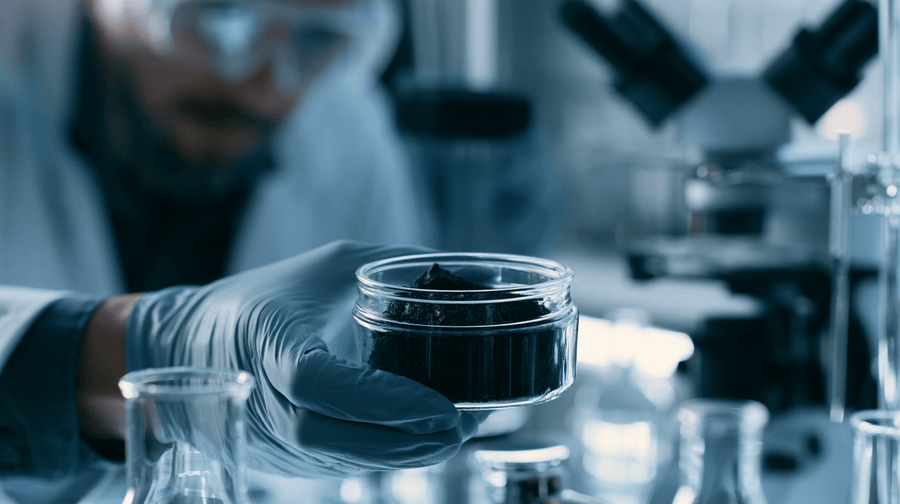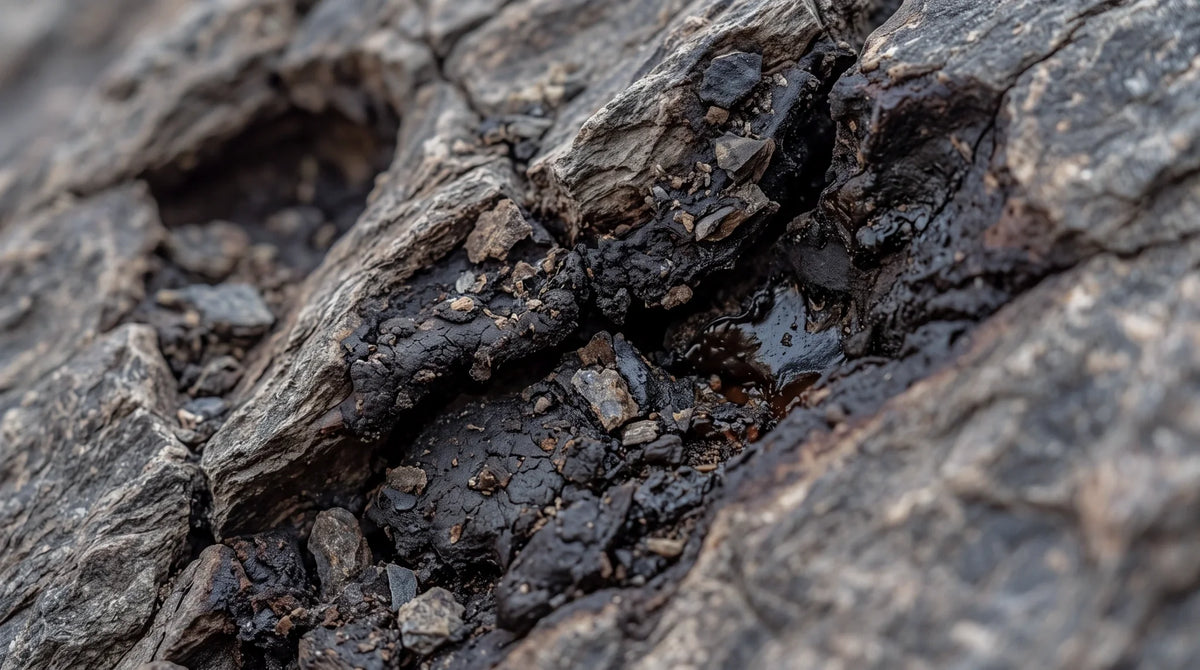
Shilajit is a dark, sticky resin that seeps out of rock faces high in mountain ranges, most famously the Himalayas, but also the Karakoram, the Altai and the Caucasus. Fresh from the mountain it looks like thick tar. Dried and purified, it becomes the glossy, jet-black resin sold today.
How shilajit forms
Shilajit is not mined like a mineral, and it is not a plant extract. It forms slowly, over centuries, as ancient plant and organic matter is compressed between layers of rock and broken down by microbes under pressure. In warm weather the softened resin oozes out of cracks in the stone, typically at altitudes between roughly 1,000 and 5,000 metres, where it can be collected by hand.

The result is a dense natural material rich in fulvic acid and humic substances, along with a spectrum of trace minerals. Its exact composition varies with the mountain, the altitude and, crucially, how it is processed. That variation is the reason independent testing matters so much with shilajit.
A short history
The name comes from Sanskrit: shilajatu is commonly translated as "conqueror of mountains" or "rock-destroyer". Shilajit appears in classical Ayurvedic literature, including the Charaka Samhita, where it is described as a rasayana, a traditional tonic. Mountain communities across the Himalayan region and Central Asia have gathered it for generations and passed down their own methods for collecting and preparing it.

It is worth being clear about what that history tells you. Tradition shows how long people have valued shilajit. It is not clinical proof of any health effect, and modern research is still early. What modern science can do, and what tradition could never do, is verify what is actually in the jar.
Why history is not enough today
Raw shilajit gathered from open rock can carry soil, bacteria and heavy metals. That is why serious producers purify it and test every batch. A traditional story is a good reason to be curious. A laboratory report is the reason to trust a product.
What to take from this
- Shilajit is a mountain resin formed over centuries, not a mined mineral or a plant extract.
- Its main organic component is fulvic acid, together with trace minerals.
- Its long history is cultural evidence, not clinical proof.
- Purity depends on how it is collected, processed and tested.
Curious how it is turned from mountain tar into a pure resin? Read how shilajit is harvested and purified, or see the independent lab results behind every Montavita batch.